What is Dungeons & Dragons?
Disclosure: This post contains affiliate links. If you click on these links and make a purchase, we may earn a commission. This commission helps us to keep the site running and provides you with more helpful content. However, this does not influence our reviews, which are always honest and unbiased. We only recommend products or services that we believe will be of value to you.
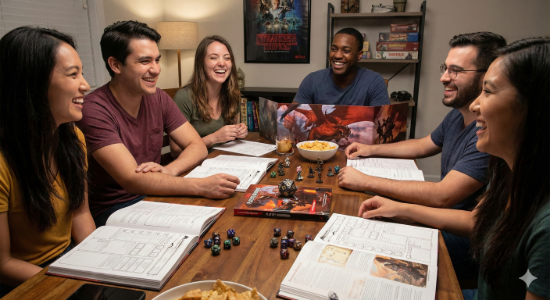
If you have watched Stranger Things, laughed at The IT Crowd, or wiped away a tear during E.T., you have already brushed shoulders with the cultural juggernaut that is Dungeons & Dragons (D&D).
For decades, this game was whispered about as a niche hobby for "geeks" in basements. Today, it is a global phenomenon, a spectator sport, and a storytelling engine that powers some of Hollywood’s biggest hits. As an avid Dungeon Master (DM) myself, I have watched this hobby evolve from pencil and paper obscurity to a vibrant, worldwide community.
But what actually is it? Is it a board game? An acting workshop? A maths test?
Grab your tea and pull up a chair. Whether you are a parent looking to connect with your children, a fantasy lover, or just someone looking for a new way to socialise, let’s peel back the parchment and discover the magic of D&D.
The Pop Culture Phenomenon: You Know More Than You Think
Before we roll a single die, let’s look at the breadcrumbs D&D has left across pop culture. You might be surprised to find you are already familiar with the concepts.
The Silver Screen
Dungeons & Dragons: Honor Among Thieves (2023): This recent blockbuster finally captured the chaotic, hilarious, and heart-warming energy of a real D&D session. It wasn't just a fantasy movie; it was a love letter to the feeling of playing with friends.
Onward (2020): Pixar’s heartfelt film uses classic D&D tropes, gelatinous cubes, beholders, and the quest for magic, to tell a story about brotherhood.
E.T. the Extra-Terrestrial (1982): Remember the opening scene? Elliott trying to join his brother’s game? That was D&D. It grounded the sci-fi classic in real, relatable suburban life.
Dungeons & Dragons (2000): Whilst... less critically acclaimed than the 2023 film, it remains a testament to the game’s enduring struggle and eventual triumph in reaching the mainstream.
TV Series: The New Golden Age
Stranger Things (2016–present): Arguably the catalyst for the modern "D&D Renaissance." The show uses D&D monsters (The Demogorgon, Vecna) as metaphors for the characters' trauma. It showed the world that D&D is the ultimate bonding experience for friends.
The Legend of Vox Machina (2022–present): This Amazon Prime series is unique. It is a direct animated adaptation of a D&D campaign played by voice actors in the web series Critical Role. It proves that a game played at a table can generate stories rivaling Game of Thrones.
The IT Crowd ("Jen the Fredo"): A hilarious look at the corporate side of D&D, showing how roleplaying can bridge gaps between "socially awkward" IT staff and "normal" managers.
Community ("Advanced Dungeons and Dragons"): Widely regarded as one of the best episodes of the series, it treats the game with surprising respect, using it to save a student from depression.
Freaks and Geeks ("Discos and Dragons"): A cult classic moment where the cool guy joins the geeks, realising that being a hero in a fantasy world is actually incredibly fun.
The Literary Roots
Long before it was on Netflix, D&D lived in the imagination of readers.
The Legend of Drizzt by R.A. Salvatore: This series made the Dark Elf (Drow) an icon. Drizzt Do’Urden is perhaps the most famous D&D character of all time.
Dragonlance Chronicles by Margaret Weis and Tracy Hickman: These books defined high fantasy for a generation, born directly from the authors' home games.
Guardians of the Flame by Joel Rosenberg: A meta-take on the genre where students are transported into the game world.
So, What Is Dungeons & Dragons?
At its heart, Dungeons & Dragons is a cooperative tabletop role-playing game (TTRPG).
Unlike monopoly or chess, there is no "winning" in the traditional sense. You don't play to beat the other players; you play to create a story with them. It is a unique blend of improv acting, tactical wargaming, and collaborative storytelling.
How It Works: The Theatre of the Mind
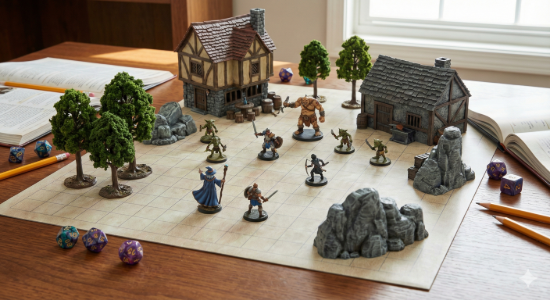
The game takes place largely in the imagination, a space we call "The Theatre of the Mind," though often aided by maps and miniatures.
1. The Dungeon Master (DM):
One player takes on the role of the DM. Think of them as the Lead Writer, the Director, and the Narrator combined. They describe the world:
"You stand before a towering iron gate, rusted with age. A cold wind howls through the cracks, smelling of sulphur. What do you do?"
The DM also controls the enemies (monsters) and the Non-Player Characters (NPCs), everyone from the barkeep to the King.
2. The Player Characters (PCs):
The other players control a single hero each. These characters have distinct personalities, abilities, and backstories.
The Fighter: A master of martial combat.
The Wizard: A scholar who bends reality with magic.
The Rogue: A stealthy expert in locks and shadows.
The Cleric: A warrior-priest who heals the wounded.
3. The Gameplay Loop:
The game follows a simple rhythm:
The DM describes the situation.
The Players describe what they want to do. ("I want to climb the wall" or "I try to persuade the guard.")
The Dice decide the outcome.
This is where the famous 20-sided die (d20) comes in. You roll the die to see if you succeed. High numbers are good; low numbers are bad. The DM uses a set of rules to determine the "Target Number" you need to hit.
Roll a 1: A "Critical Fail." You try to jump the chasm but trip over your own laces.
Roll a 20: A "Critical Success." You not only jump the chasm; you do a backflip and land looking heroic.
It’s Not Just Knights and Dragons
One of the biggest misconceptions about D&D is that it is strictly "Lord of the Rings" fantasy. While that is the default, the D&D system is a framework that can support almost any genre.
Horror: Investigate haunted mansions and battle eldritch terrors.
Sci-Fi: Explore alien planets and ancient tech.
Mystery: Solve crimes in a sprawling Victorian-esque city.
Your campaign can be a grim, gritty survival story, or a light-hearted romp full of jokes and absurdity. The tone is entirely up to the people at the table.
Who Can Play? (Spoiler: Everyone)
D&D has shattered its old stereotypes. It is no longer a boys' club. It is a game for:
Families: Grandparents playing with grandchildren find it a wonderful way to bridge the generational gap. It encourages reading, maths, and teamwork in a fun environment.
Couples: A great way to spend an evening together without staring at phones.
The Socially Anxious: Many people find it easier to socialise when they are "in character." It provides a structured social environment where the rules of engagement are clear.
Where to Play?
In-Person: The classic experience. Snacks on the table, dice rolling across the wood, and face-to-face laughter.
Online (Virtual Tabletop): Geography is no longer a barrier. Platforms like D&D Beyond, Roll20, and Foundry VTT allow you to play with friends across the globe. You get digital character sheets, 3D dice, and video chat, making it incredibly accessible.
What D&D Gives You: The Hidden Benefits
Why do people commit hours to this? Some campaigns span years (I have run one that lasted three years!). It is because D&D offers something video games cannot.
1. Unbound Freedom
In a video game, if you try to open a door and the programmers didn't want you to, it’s locked. In D&D, if the door is locked, you can try to pick it. If that fails, you can burn it down. If that fails, you can try to teleport through it. The only limit is your imagination.
2. Empathy and Social Skills
Playing a character different from yourself builds empathy. You might play a character who is greedy, heroic, or fearful, exploring emotions you don't usually express. It creates a safe space to explore identity.
3. The Story is Yours
There is a profound satisfaction in building a story together. No one, not even the DM, knows exactly how it will end. That shared surprise is addictive.
Want to See It in Action?
If you want to understand the flow of the game before buying anything, YouTube is your friend.
The gold standard is Critical Role. This is a show where professional voice actors play D&D. It is high drama, high production value, and incredibly entertaining.
Recommendation: Check out their YouTube channel. While their campaigns are long, watching just one episode will show you the potential of collaborative storytelling. (Keep an eye out for their campaigns; they are currently deep into Campaign 4, but their archives are timeless).
How to Get Started: The Toolkit
You don’t need to spend a fortune to start. All you really need is a pencil, paper, some dice, and your imagination. However, if you are ready to dive in, here are the Three Core Books you will eventually want.
1. The Player’s Handbook (PHB)
This is the essential rulebook. It contains:
Rules for creating characters (Races, Classes, Backgrounds).
The rules of combat and exploration.
The list of spells and equipment.
If you only buy one book, buy this one.
2. The Dungeon Master’s Guide (DMG)
A guide for the storyteller. It includes:
Advice on how to build worlds and write adventures.
Rules for magic items (swords that burst into flame, cloaks of invisibility).
Optional rules to make the game harder or easier.
3. The Monster Manual (MM)
A bestiary of enemies. It provides the statistics and lore for:
Classic monsters: Dragons, Goblins, Orcs.
Terrifying creatures: Beholders, Mind Flayers, Displacer Beasts.
The Easy Route: Starter Sets
If three hardback books sound intimidating, look for the D&D Starter Set (see our review on Dragons of Stormwreck Isle) or the Essentials Kit. These boxes contain simplified rules, pre-made characters, a set of dice, and a pre-written adventure. They are designed specifically to teach you the game as you play.
Final Thoughts from MsBrowns
Dungeons & Dragons is more than a game. It is a vehicle for connection. In a world that is increasingly digital and disconnected, sitting around a table (virtual or physical) to tell a story with friends is a radical act of creativity.
Whether you are a brave Knight, a cunning Rogue, or the Dungeon Master weaving the tale, there is a seat at the table for you.
Ready to roll for initiative?